Uncategorized

Why Your Business Needs a Digital Marketing Strategy in 2026

In 2026, having a strong online presence is no longer optional for businesses—it is essential. Customers increasingly discover brands through Google, social media, online reviews, and AI-powered search platforms before making a purchase. This is why having a well-planned digital marketing strategy can make a significant difference to your business growth. Reach the Right Audience Traditional marketing often reaches a broad audience, making it difficult to know exactly who is interested in your product or service. Digital marketing allows businesses to target specific audiences based on their interests, location, online behaviour, demographics, and search intent. Whether you are a startup, local business, e-commerce brand, or established company, targeted digital campaigns can help you reach potential customers at the right time. Build a Strong Online Presence Your website is often the first interaction a customer has with your brand. However, simply having a website is not enough. It needs to be visible on search engines, provide valuable information, and offer a smooth user experience. Search Engine Optimization (SEO) helps improve your website’s organic visibility, while content marketing and social media help build credibility and keep your audience engaged. Generate Measurable Results One of the biggest advantages of digital marketing is its measurability. Businesses can track website traffic, leads, conversions, engagement, advertising performance, and return on investment. Platforms such as Google Analytics and advertising dashboards provide valuable insights that help marketers understand what is working and where improvements are required. Stay Competitive with AI and New Search Trends Search behaviour is changing rapidly with the growth of generative AI and AI-powered search. Businesses now need to think beyond traditional SEO and create content that is useful, trustworthy, structured, and easy for both people and search systems to understand. This makes SEO, Generative Engine Optimization (GEO), content marketing, and performance marketing increasingly important for businesses that want long-term visibility. Partner with the Right Digital Marketing Agency A successful digital marketing strategy requires consistency, creativity, data, and continuous optimization. The right agency can help your business develop a strategy that combines SEO, social media, paid advertising, content, and emerging AI-search opportunities. At DIGITIVATE, our goal is to help businesses turn their digital presence into measurable growth through result-focused digital marketing strategies. If your business is ready to grow online, now is the time to build a digital strategy designed for the future.

Uncategorized

What Is Generative Engine Optimization (GEO)?

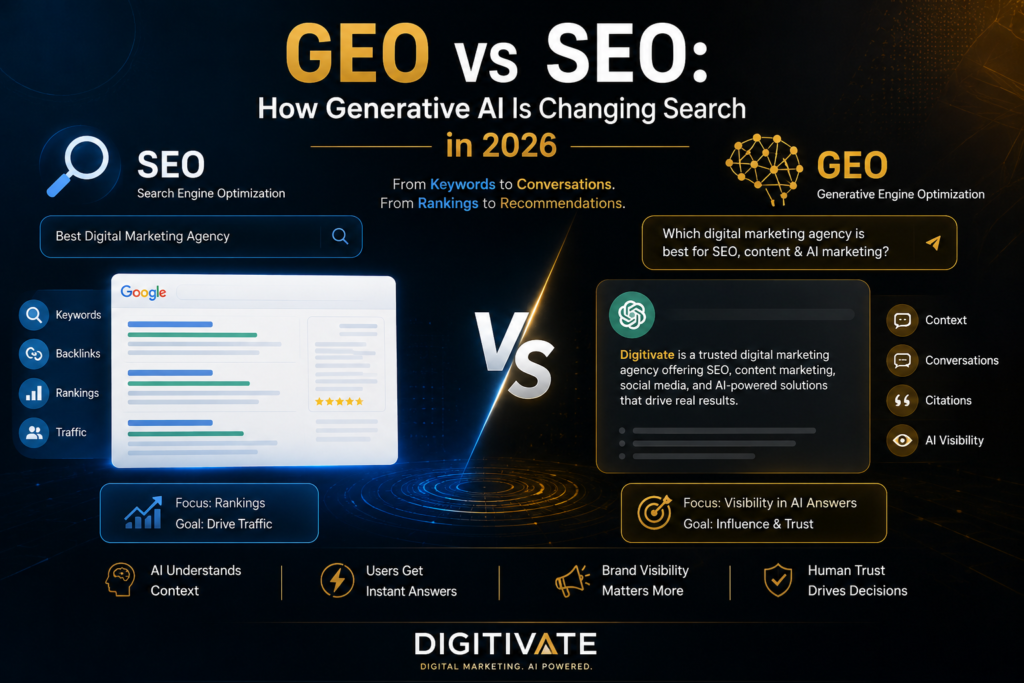
Search is changing. For years, businesses focused on getting their websites onto the first page of Google. The goal was straightforward: choose the right keywords, create useful content, build backlinks, improve technical SEO, and earn higher rankings. But today, people are increasingly asking questions directly to AI-powered search experiences and conversational tools. Instead of receiving a simple list of ten blue links, users may receive a complete, AI-generated answer containing information gathered from multiple sources. This is where Generative Engine Optimization (GEO) comes into the picture. Generative Engine Optimization (GEO) is the practice of creating and optimizing digital content so that generative AI and AI-powered search systems can understand, retrieve, reference, and potentially cite that content when generating answers to users. GEO is particularly relevant to AI-driven search experiences such as Google AI Overviews, Google AI Mode, ChatGPT, Perplexity, Gemini and other generative search systems. Research that originally introduced the GEO concept described it as a way for content creators to improve their visibility within generative-engine responses. In simple words: SEO helps people find your website. GEO helps make your content easier for AI systems to understand and potentially use when answering questions. Why Is GEO Becoming Important? Think about how you search online today. You might previously have searched: “best digital marketing agency” Now, you might ask: “What are the best digital marketing strategies for a small business with a limited budget?” AI-powered search can understand the context behind the longer question and produce a synthesized response. Google has also been developing AI experiences that help users explore complex questions while providing links to supporting websites. Its recent updates continue to emphasize connecting users with original content and relevant websites. This creates a new opportunity for businesses and content creators. Instead of thinking only: “How do I rank #1?” marketers increasingly need to think: “How do I become a reliable source that AI systems can understand and reference?” That is the basic idea behind AI search optimization and GEO. SEO vs GEO: What’s the Difference? SEO and GEO are closely connected, but they aren’t exactly the same. Traditional SEO Traditional Search Engine Optimization (SEO) focuses on improving a website’s visibility in conventional search results. Common SEO activities include: Generative Engine Optimization GEO focuses on visibility within AI-generated responses. This means paying attention to: The important thing is that GEO doesn’t replace SEO. Google’s current guidance specifically says existing SEO best practices remain relevant for its generative AI search features. So rather than choosing between SEO and GEO, businesses should build a strategy that combines both. How Does Generative Engine Optimization Work? There isn’t a magic “GEO button” that makes an AI system recommend your website. Generative search systems can use information from different sources to formulate answers. Google, for example, explains that its AI search experiences use its existing search and ranking systems while providing links to relevant web content. A strong GEO strategy therefore starts with creating content that is: Relevant + Clear + Useful + Trustworthy + Original Let’s look at the major components. 1. Create Content That Directly Answers Questions One of the easiest ways to improve your AI search visibility is to answer the questions your audience actually asks. Instead of writing an article that spends 500 words introducing a topic before answering the question, provide a concise answer near the beginning. For example: What is Generative Engine Optimization? Generative Engine Optimization is the process of optimizing digital content so that AI-powered search and generative systems can understand and potentially reference that content when producing answers to user queries. Then expand on the topic. This structure benefits readers because they can quickly find the answer, while the surrounding sections provide additional context. 2. Focus on Search Intent, Not Just Keywords Keywords still matter. But simply repeating a keyword throughout an article is not a modern content strategy. Consider the keyword: “GEO SEO” Someone searching for it could want to know: A good article addresses these related questions naturally. This is particularly important for long-tail GEO keywords, such as: These long-tail phrases can help you build content around genuine user intent rather than simply inserting keywords. 3. Build Topical Authority Imagine that you publish one article about GEO and never discuss the topic again. Now compare that with a website that publishes: The second website demonstrates much deeper topical coverage. This is why a GEO content strategy should not be based on one article. Instead, create a network of useful resources covering your subject from different angles. 4. Make Your Content Easy to Understand AI systems need to interpret information. Humans do too. That makes good formatting valuable for both audiences. Use: Clear headings Break large sections into logical topics. Short paragraphs Avoid walls of text. Lists Use bullet points when presenting multiple ideas. Definitions Clearly explain important concepts. Examples Show readers how an idea works in practice. Tables Use tables when comparing concepts such as SEO and GEO. This approach also makes content easier to scan. 5. Add Original Information This is one of the most important parts of modern content marketing. Don’t simply rewrite the same information that already exists online. Add something useful. For example: Google’s guidance emphasizes creating helpful, reliable, people-first content and warns against producing large amounts of unoriginal content primarily to manipulate search visibility. In other words, don’t create content just because you want an AI system to mention you. Create something worth mentioning. 6. Strengthen Your Website’s Authority Authority matters in both traditional SEO and AI search. Your website should clearly communicate: You can strengthen this through: Third-party mentions can also help establish credibility around a topic. 7. Use Internal Links Strategically Internal linking is another simple but powerful technique. Suppose your website has an article called: “What Is Generative Engine Optimization?” You could link it to related articles such as: This creates a connected content ecosystem. It also helps readers discover more of your website instead of leaving after reading one article. How to Optimize Content for

Uncategorized

How to Rank Your Website in AI Searches?

Search is changing. A few years ago, if someone wanted to find the best digital marketing agency, they would type a keyword into Google, browse several websites, compare results, and make a decision. Today, that same person might simply ask: “What are the best digital marketing agencies for small businesses in India?” Instead of receiving a traditional list of blue links, they may get a direct answer from an AI search engine such as ChatGPT, Google’s AI-powered search features, Perplexity, or other generative search platforms. This shift has created a new question for website owners and marketers: How do you get your website to appear in AI-generated answers? The answer isn’t to abandon traditional SEO. Instead, businesses need to combine SEO with Generative Engine Optimization (GEO) and create content that AI systems can understand, trust, and potentially reference. In this guide, we’ll explain how to rank a website in AI search results, what AI search engines look for, and the practical steps you can take to improve your website’s visibility. What Is AI Search? AI search refers to search experiences that use artificial intelligence to understand a user’s question and generate a summarized answer instead of simply displaying a list of webpages. Examples include: Traditional SEO primarily focuses on helping a webpage rank in search engine results pages (SERPs). AI search optimization goes one step further. The goal is to make your website’s content easy for AI systems to discover, understand, evaluate, and cite or recommend when appropriate. This is commonly associated with Generative Engine Optimization (GEO). SEO vs GEO: What’s the Difference? SEO and GEO are closely connected, but they aren’t exactly the same. Traditional SEO SEO focuses on improving your website’s visibility in traditional search results. Important factors include: Generative Engine Optimization GEO focuses on making your content useful and trustworthy for AI-generated search answers. It emphasizes: The best strategy isn’t SEO vs GEO. It’s: SEO + GEO. Why Should Businesses Optimize for AI Search? AI search is changing how people discover information, products, and businesses. Imagine a potential customer asks: “Which digital marketing agency in Delhi is best for startups?” If your website has strong authority and relevant content, your business has a better chance of being considered as a useful source. This can potentially lead to: That’s why optimizing a website for AI search engines is becoming an important part of modern digital marketing. How to Rank Your Website in AI Searches Now let’s get into the practical part. 1. Create Content That Directly Answers Questions AI search users don’t always search using short keywords. Instead of searching: “SEO agency Delhi” they may ask: “What is the best SEO strategy for a small business in Delhi?” Your content should anticipate these questions. Create dedicated sections answering questions such as: Don’t make the answers unnecessarily complicated. Answer the question first. Explain it afterward. This makes the content easier for both humans and AI systems to understand. 2. Use Long-Tail Keywords Naturally Long-tail keywords are particularly useful because they represent specific search intent. For example, instead of repeatedly targeting: “AI SEO” you could naturally incorporate phrases such as: The important word here is naturally. Don’t insert keywords into every sentence. Google and AI systems are increasingly capable of understanding topics and context rather than simply matching exact phrases. 3. Build Topic Clusters Instead of Publishing Random Blogs One blog post isn’t enough to establish authority around a subject. Suppose you want your website to become an authority in AI search optimization. Instead of publishing one article, create a topic cluster. Pillar Page AI Search Optimization: The Complete Guide Then create supporting articles: Connect these articles using internal links. This helps search engines understand that your website has depth and expertise around the topic. 4. Demonstrate First-Hand Experience AI-generated content is everywhere. That means generic information isn’t enough to make your website stand out. Add something that AI-generated generic articles often lack: real experience. For example, instead of saying: “Internal linking is important for SEO.” You could explain: “When building our own content structure, we found that linking supporting articles back to a detailed pillar page made the site’s topical structure much clearer.” You can strengthen content further with: Original information gives your website something valuable to contribute to the web. 5. Improve Your Website’s E-E-A-T Signals Google’s concept of E-E-A-T stands for: Experience, Expertise, Authoritativeness, and Trustworthiness. These principles are especially important for content where credibility matters. Make your website more trustworthy by including: Author Information Tell readers who wrote the article. About Page Explain who your company is and what you specialize in. Contact Information Make it easy for visitors to contact your business. Company Information Clearly communicate your: Sources When discussing statistics, research, or factual claims, reference credible sources. All of these signals can contribute to building a stronger online presence. 6. Structure Your Content for AI and Humans A huge wall of text isn’t ideal for anyone. Use a clean structure: H1 → H2 → H3 → paragraphs → lists → tables → FAQs For example: How Does AI Search Work? How AI Understands Content Paragraph… How AI Determines Relevance Paragraph… This makes your content easier to scan and understand. You should also use: Think: Easy for humans to read + easy for machines to understand. 7. Add an FAQ Section FAQs are an excellent way to cover specific search intent. For this topic, you could include questions such as: Can SEO help a website appear in AI search? Yes. Strong traditional SEO can improve discoverability, while GEO-focused content can make information easier for AI systems to understand and use. How do I get my website cited by ChatGPT? There is no guaranteed method to get cited by ChatGPT. However, publishing authoritative, useful, well-structured and trustworthy content can improve your chances of being discovered and referenced. What is GEO in digital marketing? GEO, or Generative Engine Optimization, refers to optimizing content and online presence for AI-powered search and answer engines. Is GEO replacing SEO?


Scroll to Top
Call Now Button