
Search is changing.
For years, businesses focused on getting their websites onto the first page of Google. The goal was straightforward: choose the right keywords, create useful content, build backlinks, improve technical SEO, and earn higher rankings.
But today, people are increasingly asking questions directly to AI-powered search experiences and conversational tools.
Instead of receiving a simple list of ten blue links, users may receive a complete, AI-generated answer containing information gathered from multiple sources.
This is where Generative Engine Optimization (GEO) comes into the picture.
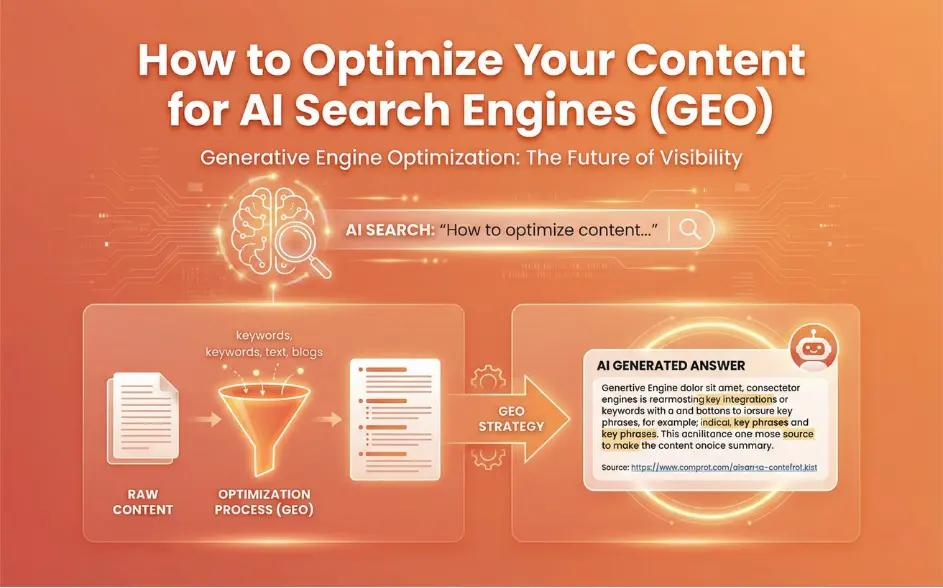
Generative Engine Optimization (GEO) is the practice of creating and optimizing digital content so that generative AI and AI-powered search systems can understand, retrieve, reference, and potentially cite that content when generating answers to users.
GEO is particularly relevant to AI-driven search experiences such as Google AI Overviews, Google AI Mode, ChatGPT, Perplexity, Gemini and other generative search systems.
Research that originally introduced the GEO concept described it as a way for content creators to improve their visibility within generative-engine responses.
In simple words:
SEO helps people find your website. GEO helps make your content easier for AI systems to understand and potentially use when answering questions.
Why Is GEO Becoming Important?
Think about how you search online today.
You might previously have searched:
“best digital marketing agency”
Now, you might ask:
“What are the best digital marketing strategies for a small business with a limited budget?”
AI-powered search can understand the context behind the longer question and produce a synthesized response.
Google has also been developing AI experiences that help users explore complex questions while providing links to supporting websites. Its recent updates continue to emphasize connecting users with original content and relevant websites.
This creates a new opportunity for businesses and content creators.
Instead of thinking only:
“How do I rank #1?”
marketers increasingly need to think:
“How do I become a reliable source that AI systems can understand and reference?”
That is the basic idea behind AI search optimization and GEO.
SEO vs GEO: What’s the Difference?
SEO and GEO are closely connected, but they aren’t exactly the same.
Traditional SEO
Traditional Search Engine Optimization (SEO) focuses on improving a website’s visibility in conventional search results.
Common SEO activities include:
- Keyword research
- On-page optimization
- Technical SEO
- Internal linking
- Backlink building
- Website speed optimization
- Search intent optimization
- Creating helpful content
Generative Engine Optimization
GEO focuses on visibility within AI-generated responses.
This means paying attention to:
- Clear and direct answers
- Topical authority
- Accurate information
- Strong contextual relevance
- Credible sources
- Structured content
- Brand mentions
- Entity understanding
- Original insights
- Content that is easy for machines and humans to interpret
The important thing is that GEO doesn’t replace SEO.
Google’s current guidance specifically says existing SEO best practices remain relevant for its generative AI search features.
So rather than choosing between SEO and GEO, businesses should build a strategy that combines both.
How Does Generative Engine Optimization Work?
There isn’t a magic “GEO button” that makes an AI system recommend your website.
Generative search systems can use information from different sources to formulate answers. Google, for example, explains that its AI search experiences use its existing search and ranking systems while providing links to relevant web content.
A strong GEO strategy therefore starts with creating content that is:
Relevant + Clear + Useful + Trustworthy + Original
Let’s look at the major components.
1. Create Content That Directly Answers Questions
One of the easiest ways to improve your AI search visibility is to answer the questions your audience actually asks.
Instead of writing an article that spends 500 words introducing a topic before answering the question, provide a concise answer near the beginning.
For example:
What is Generative Engine Optimization?
Generative Engine Optimization is the process of optimizing digital content so that AI-powered search and generative systems can understand and potentially reference that content when producing answers to user queries.
Then expand on the topic.
This structure benefits readers because they can quickly find the answer, while the surrounding sections provide additional context.
2. Focus on Search Intent, Not Just Keywords
Keywords still matter.
But simply repeating a keyword throughout an article is not a modern content strategy.
Consider the keyword:
“GEO SEO”
Someone searching for it could want to know:
- What does GEO SEO mean?
- How does GEO differ from SEO?
- How can I optimize my website for AI search?
- Does GEO replace traditional SEO?
- How do I measure GEO performance?
A good article addresses these related questions naturally.
This is particularly important for long-tail GEO keywords, such as:
- what is generative engine optimization
- how does generative engine optimization work
- how to optimize website for AI search
- how to improve AI search visibility
- GEO vs SEO for businesses
- generative engine optimization strategy for small businesses
- how to get cited in AI search results
- best GEO practices for content marketing
- how to optimize content for ChatGPT search
- AI search optimization for websites
These long-tail phrases can help you build content around genuine user intent rather than simply inserting keywords.
3. Build Topical Authority
Imagine that you publish one article about GEO and never discuss the topic again.
Now compare that with a website that publishes:
- What Is GEO?
- GEO vs SEO
- How AI Search Works
- How to Optimize Content for AI Search
- AI Search Visibility
- GEO Content Strategy
- Measuring AI Search Performance
- Common GEO Mistakes
The second website demonstrates much deeper topical coverage.
This is why a GEO content strategy should not be based on one article.
Instead, create a network of useful resources covering your subject from different angles.
4. Make Your Content Easy to Understand
AI systems need to interpret information.
Humans do too.
That makes good formatting valuable for both audiences.
Use:
Clear headings
Break large sections into logical topics.
Short paragraphs
Avoid walls of text.
Lists
Use bullet points when presenting multiple ideas.
Definitions
Clearly explain important concepts.
Examples
Show readers how an idea works in practice.
Tables
Use tables when comparing concepts such as SEO and GEO.
This approach also makes content easier to scan.
5. Add Original Information
This is one of the most important parts of modern content marketing.
Don’t simply rewrite the same information that already exists online.
Add something useful.
For example:
- Your own research
- Original examples
- Case studies
- Expert opinions
- Industry observations
- Statistics
- Experiments
- Screenshots
- First-hand experience
- Unique frameworks
Google’s guidance emphasizes creating helpful, reliable, people-first content and warns against producing large amounts of unoriginal content primarily to manipulate search visibility.
In other words, don’t create content just because you want an AI system to mention you. Create something worth mentioning.
6. Strengthen Your Website’s Authority
Authority matters in both traditional SEO and AI search.
Your website should clearly communicate:
- Who created the content
- What the business does
- What the organization specializes in
- Why readers should trust the information
- Where important claims come from
You can strengthen this through:
- Author bios
- About pages
- Expert contributions
- Quality backlinks
- Industry publications
- Digital PR
- Relevant citations
- Consistent brand information
Third-party mentions can also help establish credibility around a topic.
7. Use Internal Links Strategically
Internal linking is another simple but powerful technique.
Suppose your website has an article called:
“What Is Generative Engine Optimization?”
You could link it to related articles such as:
- “SEO vs GEO”
- “What Is AI Search?”
- “How to Create SEO-Friendly Content”
- “Digital Marketing Trends”
- “Content Marketing Strategy”
This creates a connected content ecosystem.
It also helps readers discover more of your website instead of leaving after reading one article.
How to Optimize Content for AI Search
If you’re wondering how to optimize content for AI search, start with these practical steps.
Step 1: Identify real questions
Use customer conversations, search suggestions, forums, FAQs and keyword research to understand what your audience wants to know.
Step 2: Answer the main question early
Don’t make readers hunt for the answer.
Step 3: Cover related questions
Create comprehensive topical coverage.
Step 4: Use descriptive headings
Make each section’s purpose obvious.
Step 5: Support important claims
Link to trustworthy sources where appropriate.
Step 6: Add original insights
Give people a reason to choose your article instead of another generic AI-generated page.
Step 7: Keep content updated
AI search and traditional search are constantly evolving, so review important articles periodically.
Step 8: Continue traditional SEO
Technical SEO, crawlability, indexing, site architecture and useful content still matter.
What Are the Benefits of GEO?
A well-developed Generative Engine Optimization strategy can potentially help businesses increase their visibility across changing search experiences.
Some potential benefits include:
Greater AI search visibility
Your content has a better chance of being understood and considered in relevant AI-generated responses.
Stronger brand awareness
Being mentioned or referenced in relevant answers can introduce your brand to people who may never have encountered it through traditional search.
Better content structure
GEO encourages businesses to make information clearer and easier to understand.
Stronger topical authority
Creating comprehensive resources can establish your website as a valuable source within a particular subject.
More opportunities for discovery
Google has stated that its AI search experiences are designed to connect users with relevant websites and original content.
Common GEO Mistakes to Avoid
GEO is relatively new, and there is plenty of misinformation surrounding it.
Here are some mistakes to avoid.
Mistake 1: Stuffing Keywords Everywhere
Repeating “Generative Engine Optimization” 50 times won’t magically make AI systems trust your website.
Write naturally.
Mistake 2: Publishing Hundreds of AI-Generated Articles
More content isn’t automatically better.
Google explicitly warns against scaled content created primarily to manipulate rankings, including low-value AI-generated content.
Mistake 3: Copying Competitors
If your article simply says what everyone else has already said, it gives readers little reason to choose you.
Add original value.
Mistake 4: Ignoring Traditional SEO
GEO isn’t a replacement for technical SEO, content quality, crawlability or a strong website structure.
Mistake 5: Chasing Every AI Platform
Don’t try to create completely different content for every platform.
Build strong, useful content first, then monitor how it performs across different AI search experiences.
GEO and the Future of Search
The biggest change isn’t simply that AI is answering questions.
The bigger change is how people formulate questions.
Users can now ask much longer and more conversational questions.
For example:
Traditional search:
best marketing agency Delhi
Conversational AI search:
I’m launching a small business in Delhi with a limited marketing budget. What digital marketing strategies should I prioritize during the first six months?
The second question contains more context, intent and constraints.
This means businesses need to create content that answers real problems, not just isolated keywords.
Google has said that people are increasingly asking more complex questions through its AI search experiences, creating new opportunities for websites and creators to be discovered.
Is GEO Going to Replace SEO?
No.
At least not in the way many people claim.
GEO and SEO are better viewed as complementary disciplines.
Think of it this way:
SEO = visibility in traditional search
GEO = visibility in generative/AI search experiences
The strongest digital marketing strategy combines both.
Your website still needs to be technically accessible, useful, relevant and trustworthy.
At the same time, your content should be structured so that humans — and increasingly AI systems — can understand it.
Final Thoughts: Why GEO Matters
Generative Engine Optimization is more than another digital marketing buzzword.
Search is evolving from a system that primarily gives users a list of webpages into experiences that can synthesize information and provide direct answers.
That creates both a challenge and an opportunity.
Businesses that continue producing generic, repetitive content may struggle to stand out.
Businesses that invest in original, helpful, well-structured and authoritative content have a stronger foundation for visibility across both traditional and AI-powered search.
The best GEO strategy isn’t about trying to “hack” ChatGPT or Google.
It’s about becoming the kind of source that deserves to be found, understood and referenced.
Create useful content first. Optimize it intelligently. Build authority consistently.
That’s the real foundation of Generative Engine Optimization.
Frequently Asked Questions About GEO
What does GEO stand for in digital marketing?
GEO stands for Generative Engine Optimization. It refers to strategies used to improve the likelihood that content is understood, surfaced, referenced or cited within AI-generated search experiences.
What is the difference between SEO and GEO?
SEO primarily focuses on visibility in traditional search results, while GEO focuses on visibility within AI-generated answers and generative search experiences. The two strategies overlap significantly.
How can I improve my GEO ranking?
There isn’t one universal GEO ranking system. Start by creating original, authoritative, well-structured content, answering relevant questions clearly, maintaining strong SEO fundamentals and building a credible online presence.
Does GEO replace SEO?
No. GEO should complement traditional SEO rather than replace it. Google specifically states that existing SEO fundamentals remain relevant to its generative AI search features.
What are long-tail keywords for GEO?
Examples include “how to optimize website for AI search,” “how to improve AI search visibility,” “how does generative engine optimization work,” and “generative engine optimization strategy for small businesses.”